
Closing the Gap Needs Momentum. Kimberley Communities Are Already Building It
By Tyronne Garstone
The national conversation around Closing the Gap often focuses on what isn’t working. The latest data tells a troubling story: only four of the 19 national targets are currently on track.
Two of the targets showing progress are Target 8, strong economic participation and development, and Target 15, increased legal rights and interests in land and waters. These targets are on track because they are the result of decades of work by Aboriginal organisations and Traditional Owners who have fought hard to have their rights recognised.
Across the Kimberley, Aboriginal people have secured recognition of their Country under the Native Title Act 1993. Today, more than 97 per cent of the Kimberley region is subject to native title determinations, one of the most extensive areas of native title recognition anywhere in Australia.
Traditional Owners also hold other important land interests, including Indigenous Protected Areas covering over 90,000 square kilometres, the Aboriginal Lands Trust estate which makes up about 17 per cent of the Kimberley, and various pastoral leases.
Land is a key asset for Kimberley Aboriginal people. It carries immense cultural and spiritual value, but it also holds enormous economic potential.
But legal recognition alone will not close the gap. The real opportunity lies in how those rights translate into industries and economies that are socially and culturally aligned with Aboriginal people creating jobs, businesses and long-term prosperity for communities.
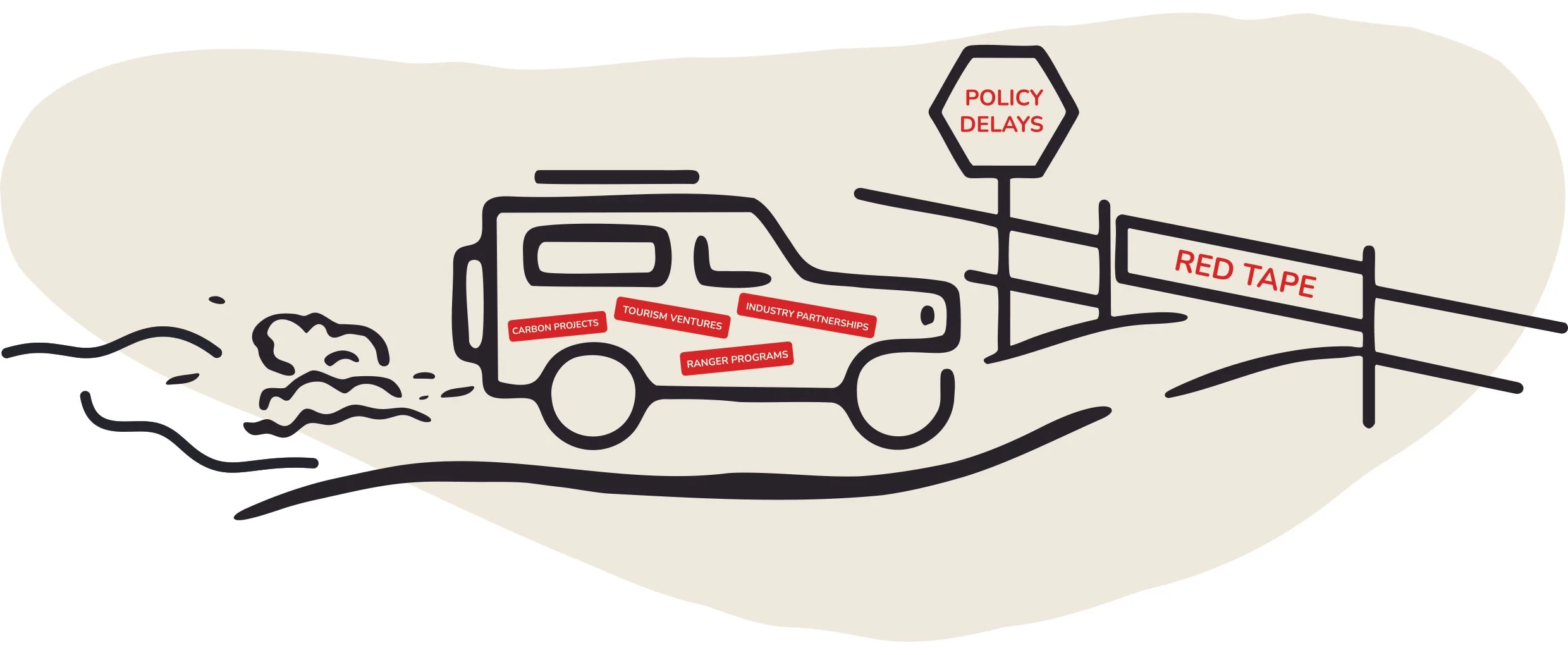
For generations, Aboriginal people have been behind the wheel of change, fighting for recognition, land rights and a voice on Country. Every determination, meeting, ranger program and Aboriginal-led organisation has pushed progress forward. Yet, as we gather speed, policy roadblocks and outdated laws stand like a gate in front of us, holding back momentum we’ve spent decades building.
In places like the Kimberley, we can feel just how close we are to shifting into the next gear after traveling a long road, but instead of accelerating, we have stalled, left idling alone.
Aboriginal people here are already driving enterprises based on Country’s strengths, including carbon projects, ranger programs, tourism ventures and industry partnerships. There is also growing opportunity in emerging sectors such as renewable energy and regenerative agriculture. These industries have the potential to place Kimberley communities at the forefront of Australia’s future economy.
But the operating environment makes this incredibly difficult. Remoteness, poor infrastructure, limited access to services and high costs all constrain the ability of First Nations groups to build and scale enterprises. These are not small hurdles, they fundamentally limit the conditions needed for entrepreneurship to thrive.
In any business environment, failure is part of success. However, for many Aboriginal organisations, there is no margin for failure. Limited access to capital and resources means that one setback can have long-term consequences, setting communities back years rather than providing lessons for growth.
Just as momentum begins to build and our communities shift into gear, outdated legislation and rigid policies continue to slow us down.
One of the biggest barriers is the legislative and market constraints on using native title land to raise capital, which means native title holders cannot leverage their rights and interests in land like land owners. This lack of parity makes it incredibly difficult for Traditional Owners to secure investment for projects on their own Country and puts them in an equal position to other land owners.
Access to capital is essential for economic self-determination. Without it, even the best ideas struggle to get off the ground.
There is a clear need for new approaches to financing Aboriginal-led development. National mechanisms such as land or investment funds could be better leveraged. For example, Recommendation 10 of the 2024 Independent Review of the Northern Australia Infrastructure Facility (NAIF) Act 2016 calls on the government to direct NAIF to notionally set aside a proportion of funds to support First Nations-owned and led projects, as well as projects with significant First Nations financial equity. There is also an opportunity to think regionally: a Kimberley-based future fund, designed by and for Kimberley Aboriginal people, could enable communities to invest in emerging industries, share risk, and build long-term equity, allowing Traditional Owners not just to participate in development, but to lead it.
At the same time, the organisations responsible for managing native title, Prescribed Bodies Corporate (PBCs), face enormous regulatory and administrative burdens.
In the Kimberley there are more than 30 PBCs managing native title on behalf of Traditional Owners.More than half operate without staff, relying on volunteer directors and support from the Kimberley Land Council just to meet basic reporting obligations.
These organisations carry huge responsibilities but are not resourced to survive, let alone thrive. If we want Aboriginal communities to participate fully in economic development, this must change.
Economic development on Country, led by Aboriginal people, does more than generate income. It creates jobs, strengthens cultural authority, supports health and education, and balances environmental impacts with cultural responsibility, benefitting the next generation.
Progress in one area drives progress across many Closing the Gap targets. It also benefits the broader economy. Greater Aboriginal participation in regional industries means faster project approvals, better local partnerships, stronger social licence and improved employment outcomes. When Traditional Owners are genuine partners, everyone benefits.
But unlocking this future also requires a shift in how governments approach agreements. Moving beyond piecemeal processes toward comprehensive regional settlements would provide greater certainty for both Traditional Owners and investors, creating a more stable foundation for long-term development.
The Kimberley is already showing what this future could look like. Our people have stood together to build strong regional organisations, develop innovative land management programs and created new economic opportunities grounded in culture and Country.
Just as momentum begins to build and our communities shift into gear, outdated legislation and rigid policies continue to slow us down.
The overburden on PBCs which impedes access to economic development opportunities on native title lands is exacerbated by the significant unresolved compensation liability of all governments across Australia. Compensation is supposed to address past wrongs and losses of native title rights, it is not a panacea for governments to meet current and future obligations to First Nations people. However, resolution of compensation liabilities could at least fast track the process of putting Traditional Owners in a better position to seize future opportunities when they arise.
If governments are serious about Closing the Gap, they must modernise legislation, invest in Aboriginal institutions, support enabling infrastructure and back long-term policy settings that extend beyond election cycles. Most importantly, they must ensure native title holders can fully utilise the rights they’ve fought so hard to secure. In the Kimberley, we are ready to accelerate towards economic self-determination, and show the rest of the country what’s possible.